
Forging Ingot Manufacturing Process
A forging ingot is made in five steps: melt, refine, degas, pour and test. Each step controls something the forge shop later depends on.
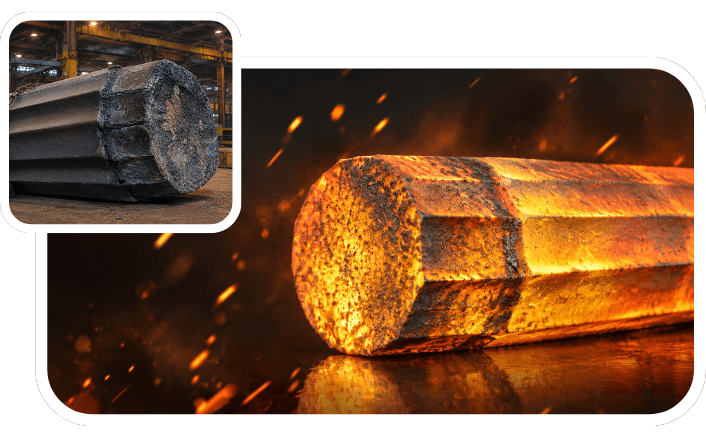
Forging ingot manufacturing process, step by step
- Electric melting furnaces melt the charge and set the base chemistry
- Ladle refining furnace (LRF) adjusts temperature and chemistry and removes sulphur
- Vacuum degassing system (VD) removes hydrogen and reduces oxygen and nitrogen
- Bottom pouring fills the mould through a runner system, away from the air
- Hot top feeding keeps the head liquid so shrinkage sits in the cropped feeder
- Stripping, cooling and, where ordered, annealing, grinding and testing
Forging ingot quality requirements
Forging ingot quality requirements are set by the forging and its code: chemistry within grade limits, low hydrogen and gas content, soundness checked by ultrasonic testing after forging, and traceability by heat. Pressure parts add IBR, PED or AD 2000 approval.
Testing
Each heat is analysed on an optical emission spectrometer, and oxygen, nitrogen and hydrogen are checked on a simultaneous analyser. PMI verifies the grade and a radioactive contamination test facility is available.
Related pages
Questions
How is a forging ingot made?
It is melted in an electric furnace, refined in a ladle furnace, vacuum degassed, bottom poured into a mould with a hot top, then stripped, cooled and tested.